Critical vacuum solutions for space missions
Mitigating the challenges of the space sector
Of all the work environments imaginable, space must represent the most hostile of all.
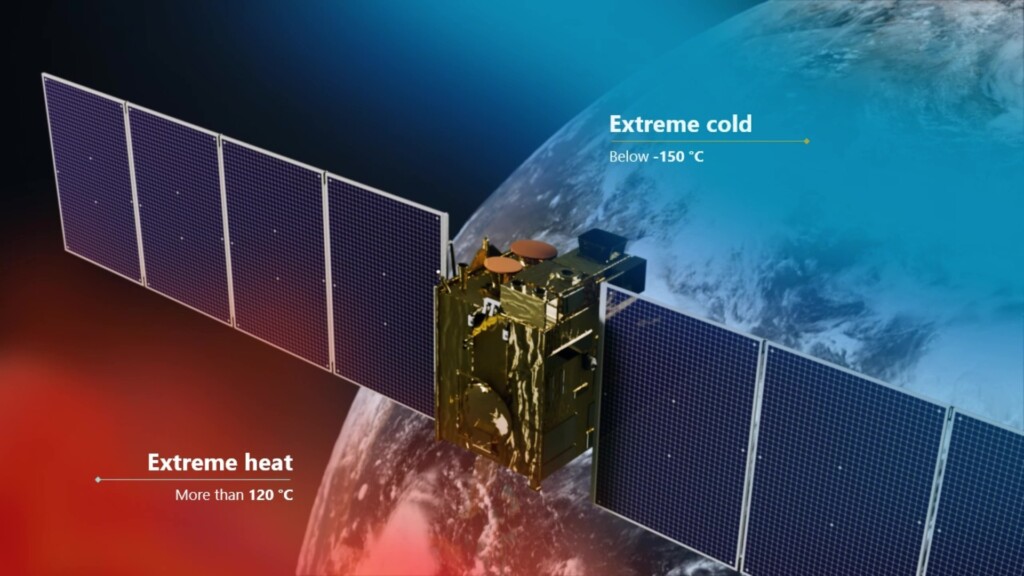
Take the ISS (International Space Station) where the sunny side heats up to +121 °C, but temperatures on the ‘shady’ side can drop to as low as -157°C.
And the challenges aren’t limited to extreme temperatures variances or the vacuum of space. Geo-magnetic storms, long-term exposure to radiation, space dust, as well as tolerance to vibrational vent-shocking during launch and re-entry are all threats that can damage hardware and jeopardize mission success.
Managing risk, delivering compliance
Replacing infrastructure in orbit is extremely expensive and often impossible, and for this reason it is vital that all equipment is rigorously tested pre-launch, from every individual element used, to entire spacecrafts or satellites.
Our vacuum technology enables the space sector to mitigate these risks by simulating the space-like conditions in laboratory settings. Crucially this also allows projects to demonstrate regulatory certification requirements such as NASA GSFC-STD-7000, NASA-STD-7012, MSFC-SPEC-1238, and ASTM E595-15.
Qualifying components for space: Typical Test Phases
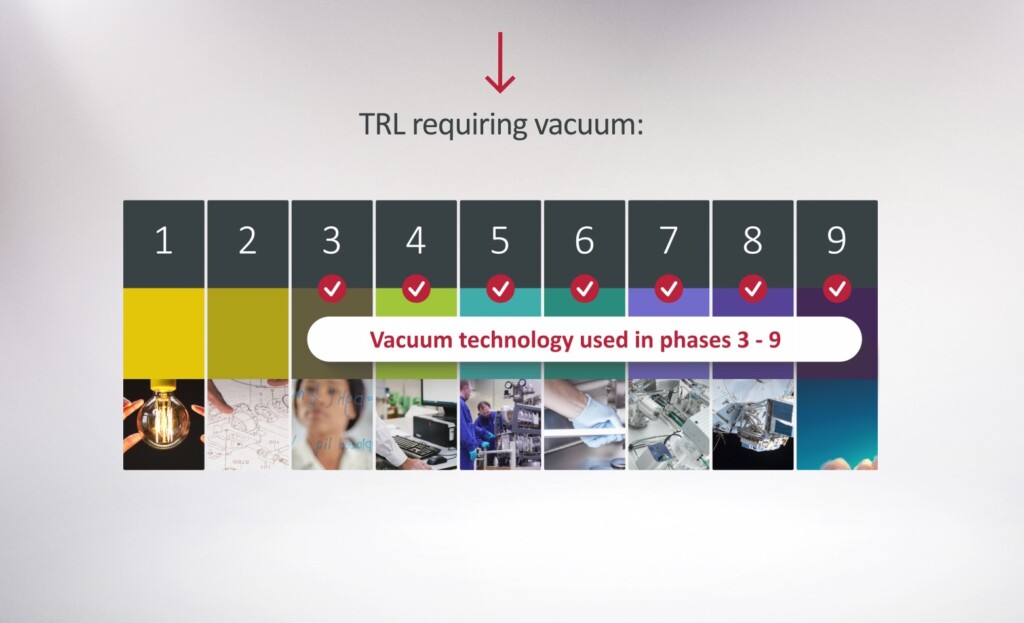
NASA’s Standard Technology Readiness Level (TRL) provides a well-worn roadmap from concept to launch. Its principles can be applied projects of all sizes:
- TRL 1: Basic principles observed and reported.
- TRL 2: Technology concept and application formulated.
- TRL 3: Analytical and experimental proof-of-concept.
- TRL 4: Component validation in a lab environment.
- TRL 5: Rigorous testing and simulations in real-world-like conditions.
- TRL 6: Prototype demonstration in relevant environments (ground or space).
- TRL 7: System prototype demonstration in a target/space environment.
- TRL 8: Actual system completed and flight-qualified through testing and demonstration.
- TRL 9: Actual system flight proven through successful mission operations
You will typically find our vacuum technology employed from Technology Readiness Levels 3 – 9.